Omni-U Education System
An Initiative of Omni-U Enterprise. Cultivating Human Potential Through Lifelong Learning. This proposed framework explores how character, inquiry, and service stay connected across life. Envisioned as a unified journey rather than isolated stages, we invite you to imagine a developmental pathway where human potential is nurtured from beginning to end.
Proposed Institutions
Green Leaf Academy

Gold Leaf College

Omni-U Institute

A Lifelong Pathway
Across the proposed system, six Guardian Pillars provide a shared ethical and developmental framework informing learning, relationship, responsibility, and contribution. These pillars serve as the structural backbone for every stage of the Omni-U educational experience.

Awareness
Developing the capacity to be present, observant, and mindful of one's own thoughts, actions, and impact on the surrounding world.

Curiosity
Cultivating an evergreen desire to ask questions, explore the unknown, and maintain an open mind toward new ideas and discoveries.

Creativity
Nurturing the ability to express unique perspectives and generate original solutions to complex challenges through various artistic and intellectual forms.

Responsibility
Embracing the duty to care for one's self, community, and environment, recognizing that every action contributes to the collective well-being of the whole. This pillar encourages learners to take ownership of their personal growth and the ethical implications of their creative and professional work.

Compassion
Fostering empathy and deep understanding for the experiences of others, ensuring that all learning and service is grounded in human dignity and kindness. Compassion is the heart of our relational model, guiding how we interact across all environments.

Service
Empowering learners to apply their unique talents and knowledge for the betterment of others, transforming personal potential into meaningful social contribution. Service at Omni-U invites individuals to address real-world needs through purposeful action and collaboration, fostering a lifelong commitment to the collective flourishing of our global community.
Guardian Pillars of Omni-U
Guided by Awareness, Curiosity, Creativity, Responsibility, Compassion, and Service, this concept anchors whole-human learning in ethical action and inquiry across one's life.
The Human Cultivation Strands
Our framework is organized around thirteen strands that work together across a lifetime: Self- Awareness, Inquiry, Character, Health, Relationship, Practical life, Finance, AI and Media Literacy , Nature, Creativity, Culture, Purpose, and Service.
Foundations of Inquiry
Learners begin with careful observation before explanation. They practice distinguishing
observation and first-person experience from inference, interpretation, assumption, memory, and
belief. They ask what is known, uncertain, missing, or contested; examine evidence and
alternative explanations; and remain willing to revise conclusions. Some questions are empirical,
while others involve philosophy, meaning, personal experience, culture, or spiritual reflection.
The framework does not require a metaphysical conclusion.
Keeping Claim Types Clear
We distinguish among several kinds of claims:
• Established findings
• Open scientific questions
• Analogy
• Philosophical interpretation
• Spiritual reflection
Scientific fields such as quantum mechanics, cosmology, neuroscience, consciousness research,
and related areas should not be used as automatic proof of a metaphysical worldview.
Many Beliefs, Shared Human Dignity
The system may explore religion, philosophy, culture, ethics, and questions of meaning,
including founder-created works, but it does not require a shared theology. Scientific evidence,
historical evidence, cultural tradition, interpretation, philosophical reflection, and fiction must be
clearly distinguished. Omni-U would never grade a learner’s spiritual belief, trauma history,
family structure, or human worth.
Learning by Age and Stage
Early learners: safety, wonder, language, play, kindness, body awareness, and family and
community belonging.
Elementary learners: curiosity, reading, mathematics, nature, creativity, cooperation, emotional
vocabulary, and early responsibility.
Middle years: identity, friendships, digital life, health, consent and boundaries, practical
problem-solving, and media literacy.
High school learners: advanced academics, career exploration, finance, civic responsibility,
service, creative production, and AI and media literacy.
College and workforce learners: professional capability, entrepreneurship, skilled trades,
continuing education, ethical technology use, and leadership through service.
Graduate and global learners: research, educator development, specialized inquiry, cross-cultural
collaboration, and service to humanity.

A Connected Journey
This conceptual model maps a unified learning trajectory, not an operational entity. As a framework in progress, active research is currently shaping the underlying architecture, including potential curricula, assessment standards, and credentialing pathways. It aims to integrate life stages into one cohesive developmental journey.

Explore More
This education system is a proposed conceptual framework under development and does not currently represent an active or accredited academic institution.
Learning Environments
This conceptual model outlines a proposed developmental framework, not an active school program. Formal curriculum, standards, assessments, and credentials require full review prior to launch.
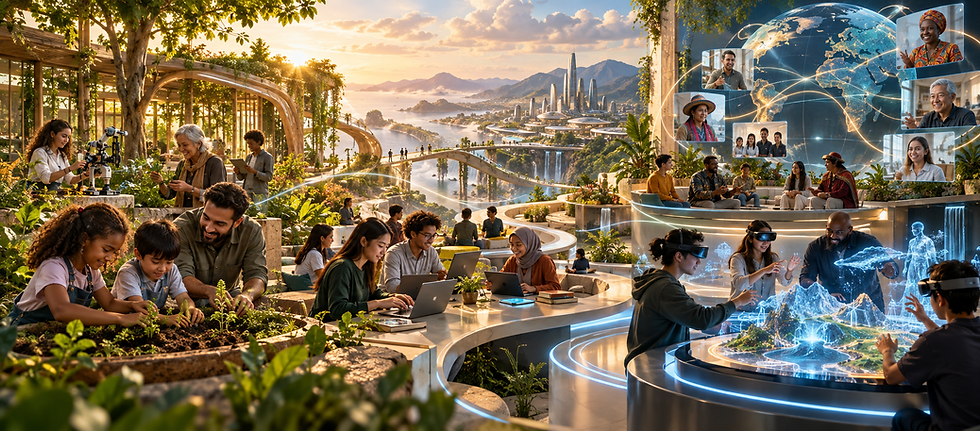
01. Physical
02. Digital
Our proposed physical foundation, integrating nature and academic structure within a sustainable community ecosystem.
We envision future online learning that could connect learners with approved lessons, educational resources, feedback, and community through ordinary devices.


03. Immersive
04. Global
Proposed optional immersive concepts for the future, offering alternate 2D, video, or printable learning modes.
Global participation is a long-term goal requiring local understanding, language access, disability access, and varied connectivity. No worldwide learner or mentor network is operating through this website.


What Omni-U Would Teach Beyond Core Subjects
The following areas describe proposed learning directions beyond core academic subjects. They are part of the Omni-U Education System’s development model and are not currently operating courses.
-
Self-awareness: Learners practice observing thoughts, emotions, assumptions, and reactions before choosing how to respond.
-
Emotional intelligence: Learners develop emotional vocabulary, self-regulation, empathy, resilience, and healthy expression.
-
Relationships: Learners study honesty, communication, consent, boundaries, compatibility, partnership, parenting, and conflict repair.
-
Personal hygiene: Learners learn cleanliness, grooming, oral care, disease prevention, and body stewardship.
-
Health and nutrition: Learners study whole-food nutrition, hydration, sleep, movement, stretching, preventive care, and qualified healthcare.
-
Financial literacy: Learners learn budgeting, saving, credit, contracts, taxes, investing, ownership, and responsible financial decisions.
-
Entrepreneurship: Learners repeatedly develop ideas, create useful products or services, understand costs, receive feedback, and improve their projects.
-
Practical home skills: Learners practice cooking, home care, maintenance, organization, household cooperation, and responsible technology use.
-
Communication and media literacy: Learners learn public speaking, source evaluation, misinformation detection, AI literacy, and responsible communication.
-
Critical inquiry: Learners distinguish observation, evidence, interpretation, belief, analogy, philosophy, spiritual reflection, and fiction.
-
Creative production: Learners explore art, writing, storytelling, filmmaking, music, design, invention, and digital creation.
-
Nature and agriculture: Learners study gardening, food growing, ecology, stewardship, animals, soil, and environmental responsibility.
-
Survival skills: Learners study shelter, fire safety, navigation, water awareness, wilderness preparation, and environment-specific survival.
-
Emergency preparedness: Learners learn how to recognize danger, seek help, respond safely, and receive age-appropriate first-aid and CPR education.
-
Personal safety: Learners study boundaries, abuse prevention, trusted adults, public safety, online safety, fire escape, and supervised self-protection.
-
Trauma-informed development: Learners receive support that respects trauma, grief, disability, neurodivergence, learning differences, and individual circumstances.
-
Accessibility and gifted development: Learners are supported according to their strengths, abilities, communication styles, pace, and support needs.
-
Civic responsibility: Learners study laws, rights, duties, consequences, ethical decision-making, and responsible participation in society.
-
Leadership: Learners practice service, accountability, humility, problem-solving, teamwork, and developing the abilities of others.
-
Community service: Learners work on supervised projects such as gardens, literacy, food access, accessibility, environmental care, and resource connection.
-
Stewardship and guardianship: Learners develop responsibility for people, communities, knowledge, safety, nature, and shared resources.
-
Technology and AI: Learners use technology thoughtfully while learning privacy, verification, digital ethics, and human oversight.
-
AR and VR learning: Learners may use optional simulations, educational films, virtual field trips, interactive scenarios, and ordinary-device alternatives.
-
Global and cultural learning: Learners study civilizations, languages, traditions, local knowledge, cultural responsibility, and cooperation across differences.
-
Purpose and philosophy: Learners explore meaning, ethics, religion, nonbelief, personal values, and different views of human life.
-
Observer practice: Learners gradually develop the ability to notice thoughts and emotions without automatically identifying with or obeying them.
-
Lifelong learning: Learners continue developing knowledge, capability, relationships, creativity, service, and wisdom through every stage of life.